07.1. Link Early Actions to Social Protection

Summary

Scaling up and embedding anticipatory action into national risk management structures is important for sustainability and effectiveness. Scaling anticipatory action depends on the capacity of the system to pre-identify potential impacts and people that will need support, to effectively implement actions in the short window of time between a forecast and the occurrence of the hazard or when its impacts fully unfold. One of the strategies for doing this includes working with national social protection systems that are often in place and could scale up in anticipation of shocks. Under this sub-chapter, we cover:

  • What is social protection?
  • Why should we link anticipatory action and social protection?
  • Why is it relevant to the work of National Societies and the humanitarian sector?
  • What does the integration of anticipatory action and social protection look like in practice?
  • Which social protection instruments can be used for anticipatory action?
  • What should be kept in mind when linking anticipatory action and social protection?

What is Social Protection?

Social protection includes policies and programs aimed at reducing poverty, inequality and vulnerability (Costella et al., 2022). Social protection is also termed as social security and/or social policy in different countries. With increasing climate related risks, social protection programs are becoming increasingly relevant as they can help protect people from the impacts of climate shocks and stressors, protecting their lives and livelihoods.

Traditionally, social protection has supported vulnerable groups to address risks that occur during one’s life cycle (e.g. unemployment, disability, old age). But due to the worsening impacts of climate change, it is expected that more people will be unable to meet their basic needs and will need additional assistance. For this reason, it is important to see how social protection systems can be strengthened and adapted to provide the necessary support against climate risks, especially in anticipation.

Social protection systems that respond to address climate shocks are commonly known as shock responsive social protection (for more info, see IFRC brief on SRSP in the toolbox), whereas systems that systematically integrate climate risk, disaster risk reduction and climate change adaptation to strengthen households’ capacity to prepare for, cope with and adapt to evolving climate impacts are termed as adaptive social protection. For more specifically on social protection related priorities, see the Red Cross Red Crescent Climate Centre Position Paper on Social Protection. Both resources can be found in the toolbox.

Why should we link anticipatory action and social protection?

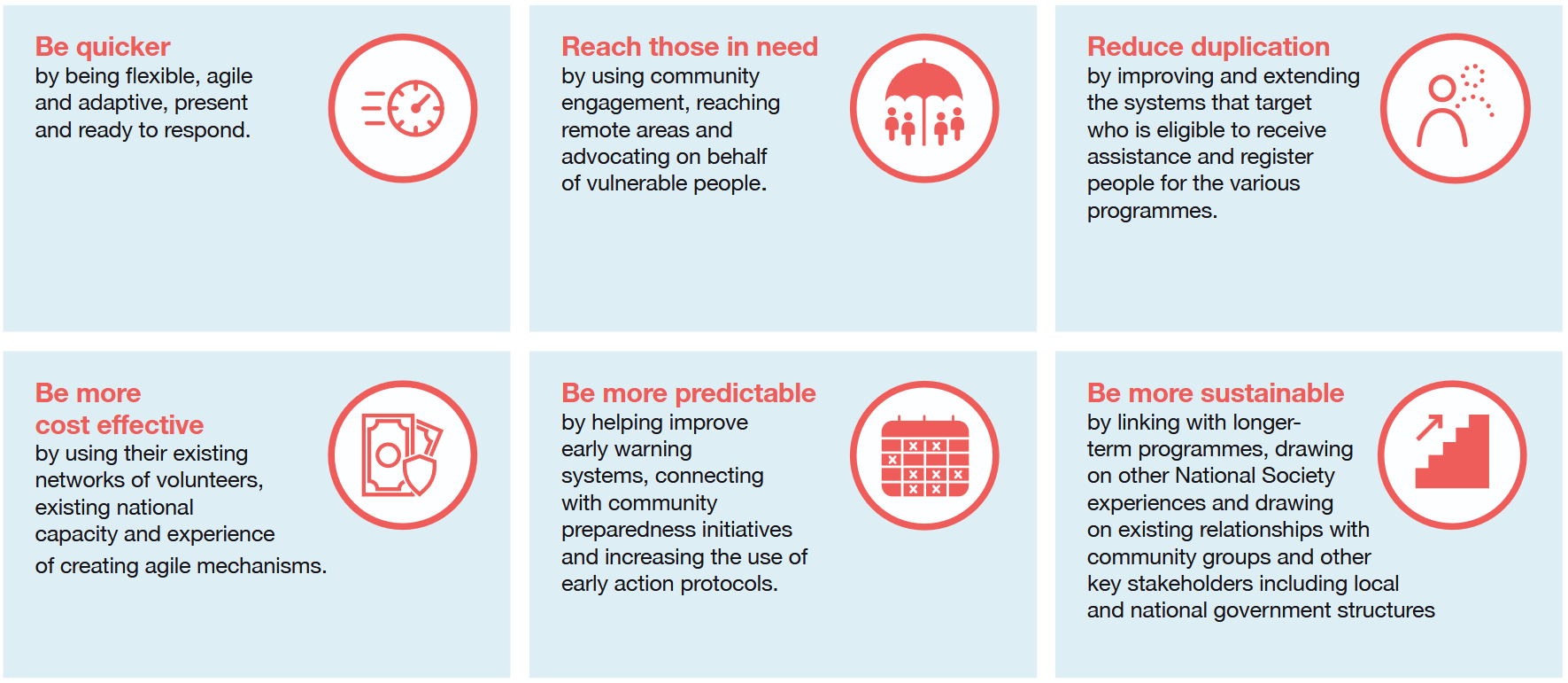
By integrating anticipatory action and social protection systems, we can harness synergies for taking anticipatory action before disaster impacts materialize, playing a critical role in reducing disaster impacts, building resilience and protecting development gains, especially by supporting some key aspects:

Anticipatory action relies on predictive models to anticipate in advance of disasters. By coupling it with existing social protection systems, support can be provided in a timely manner to vulnerable communities before a disaster strikes. As people are already in the social registry, targeting becomes faster. This pre-emptive action can help save lives and minimize the impact of the disaster.

In the last years, many governments and donors have invested in making social protection programmes shock-responsive to ensure they are able to rapidly scale up during a crisis and scale back once the crisis is over. An anticipatory action mechanism would be a key piece of such a system, helping establish objective indicators and pre-agreed plans of action as well as ring-fenced financing to enable anticipatory action through social protection.

Social protection, where they exist for a long time, comprise of large scale, long-term, nationally owned systems. These systems can reach significant sectors of the population: Safety net programs, for instance, cover 2.5 billion people globally currently (Banerjee et al., 2022) and are continually being expanded. Anticipatory action programs that use existing social protection programs can reach larger populations and newer geographies.

By using anticipatory action, social protection systems can be equipped to reduce climate/disaster risks by allowing investments in preparedness measures, such as cash for work schemes that help in reinforcing community infrastructure before a cyclone or offering training on disaster risk reduction that helps in adopting appropriate coping strategies.

When both systems are linked, communities can become resilient over the long term, across the overall disaster management cycle. When anticipatory action works through social protection, it in turn focuses on strengthening systems as well, which over time is better equipped to manage residual impacts and improve resilience.

Integrating these systems can result in cost savings by reducing the expenses associated with setting up parallel emergency response and recovery efforts after a disaster. Costs for registration, verifications or communications needed for anticipatory action can be reduced by piggy backing on existing social protection programs components like beneficiary databases.

Linking anticipatory action and social protection can promote the coming together of country actors and stakeholders in a meaningful way, to coordinate and achieve co-benefits across sectors that contribute to a long term and shared vision of resilience.

Social protection systems often target the most vulnerable groups in a society who are also most at risk from climate related shocks, as they are likely to reside in exposed areas, have pre-disposed vulnerabilities, and limited adaptive capacity. Linking these systems ensures that the most vulnerable populations are targeted for support and protection even under anticipatory action programs.

Why is it relevant to the work of the Red Cross Red Crescent Movement and the humanitarian sector?

Climate change impacts are intensifying, disproportionately affecting those who are already most vulnerable. In fragile and conflict‑affected settings, these impacts intersect with ongoing violence and instability, placing even greater strain on already overburdened humanitarian actors and systems. Cumulative needs are coupling as countries reel under the impacts of compounding crises. Under such circumstances, based on the advantages discussed above, it is increasingly practical for anticipatory action actors including National Societies to consider social protection as a tool for delivering timely humanitarian assistance, at scale. At the same time, it offers a strategic pathway towards supporting structures for Red Cross Red Crescent partners.

When implementing anticipatory action through social protection initiatives, National Societies can play a crucial role as a key partner for governments, humanitarian and development organizations, as well as donors. They can assist national governments, leveraging extensive networks of volunteers, including those in hard-to-reach areas where government presence may be limited. With representation at the village, district, and national levels, their auxiliary function, combined with experience, networks, community outreach, and expertise, enables them to contribute to the enhancement of social protection systems in a number of ways:

What does the integration of anticipatory action and social protection look like in practice?

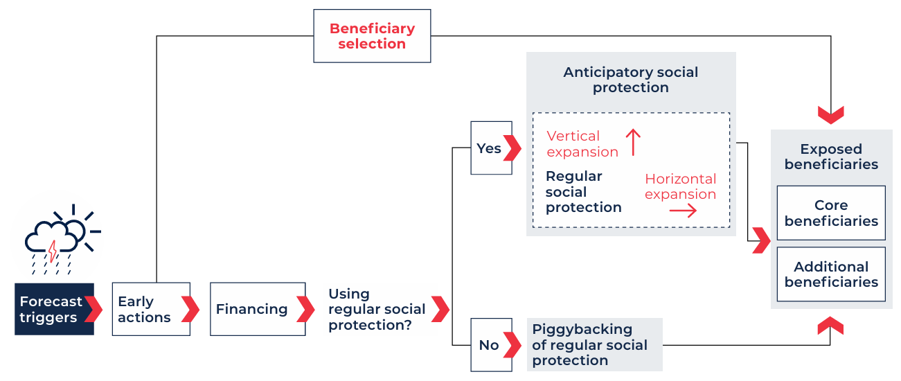
In practice, linking anticipatory action and social protection can happen in two ways:

  1. Anticipatory Action actors integrate Social Protection: When setting up an anticipatory action program in a country and determining the list of anticipatory actions to be taken, National Societies can consider whether existing national social protection programs (e.g. cash transfers, old age pensions, cash for work etc.) can be used for taking the anticipatory actions identified as relevant for the community.
  2. Social Protection actors integrate Anticipatory Action: Social protection actors can improve their policies, program design and implementation processes by including climate risk information that prepares the system for anticipatory action. For example, National Societies can share trigger information developed as part of the EAP process with social protection actors, and help integrate it as part of the program design to trigger social protection payouts before an imminent shock.

Which social protection instruments can be leveraged for anticipatory action?

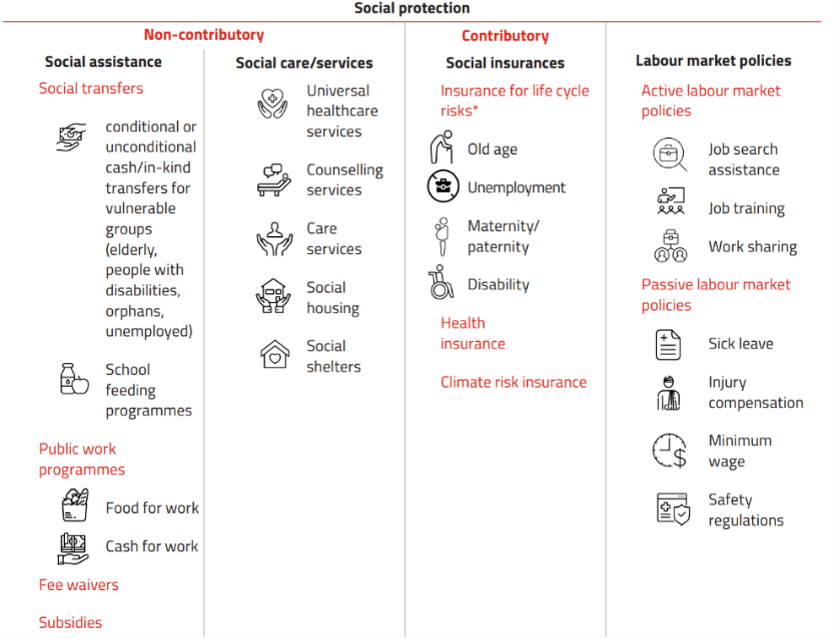
A country’s social protection system generally includes a combination of different instruments that are contributory (contributions financed) or non-contributory (tax financed) in nature, as seen in the figure above.  Many of these instruments are already familiar to National Societies and mirror modalities they use in their own programs, which means there are relatively low barriers to adopting a more integrated approach to implementing anticipatory action through social protection. Depending on what instruments are existing and operational in a country, National Societies can have different options:

  • Social transfers, (instruments like cash/food/assets transfers, disability benefits, old age pensions etc.), can be used to deliver anticipatory cash or in‑kind support through existing delivery systems, building directly on National Societies’ experience with disaster response programming.
  • Public works, can be leveraged (cash/food for work) programs to see whether anticipatory activities within the available lead time after a trigger is reached, such as relocating productive assets to safe locations, constructing/reinforcing shelters on higher ground, or clearing drainage to reduce flood risks.
  • School feeding and child focused programs could offer readily available enrolment lists with schools or Ministries of Education that National societies can use to target children, and pre-position relief material, food packages, vouchers or cash to help support families with children in school.
  • Social care services, similar to health and psychosocial support provided by National Societies in many countries, offer a concrete pathway for National Societies to link up with such networks and facilities to leverage their coverage, access and capacities, and deliver targeted health messaging, referrals and essential services to at-risk populations during the window between a trigger and the anticipated impacts.

How can National Societies engage in integration of anticipatory action and social protection?

The Red Cross Red Crescent Movement, and the National Societies in particular, have a long history of engaging with national social protection systems (see the two example boxes below). Additional information on these examples can also be found in the toolbox.

Supporting the Integration of Anticipatory Action into National Social Protection Systems in Kenya

The Kenya Red Cross Society been actively engaged in reviewing the National Social Protection Policy, and in developing the harmonized household registration tool for registering households into the Enhanced Single Registry (ESR). Most recently, KRCS has supported people to access social protection via the ESR in Taita Taveta County, Kenya. In the case of KRCS, just like many other National Societies, its established auxiliary role, long-standing relationships with government actors, and community relationships uniquely position it to support the integration of anticipatory action and social protection systems.

Using Social Protection Systems to Deliver Anticipatory Cash Assistance in Nepal

Another example is from 2021, when the Danish Red Cross transferred emergency funds to the Nepal Red Cross Society and supported the delivery of multi-purpose cash assistance to vulnerable groups within a month of peak floods. This was accomplished by utilizing Nepal’s Social Security Allowance (SSA) program, leveraging beneficiary lists to target households. Cash was directly disbursed to SSA bank accounts, addressing essential needs and aiding the early recovery of individuals prior to the visible effects of the flood. This experience demonstrated the efficacy of utilizing the government’s social protection system to efficiently and cost-effectively provide cash assistance on a large scale before or after a disaster. For more information, see the toolbox.

Depending on the technical and financial capacity of the country, different opportunities for engaging with anticipatory action exist. In general, there are some common ways by which National Societies can leverage social protection systems, irrespective of the instrument type. This includes:

  • Aligning anticipatory cash transfer amounts with existing social protection program’s benefit levels
  • Using the same targeting strategy for a new group of beneficiaries or new geographic area
  • Using already existing social protection payment channels/banks accounts
  • Using existing social protection databases/social registries/community lists of vulnerable people and previously affected groups to identify vulnerable groups
  • Using the same communication channels and trusted means of information dissemination

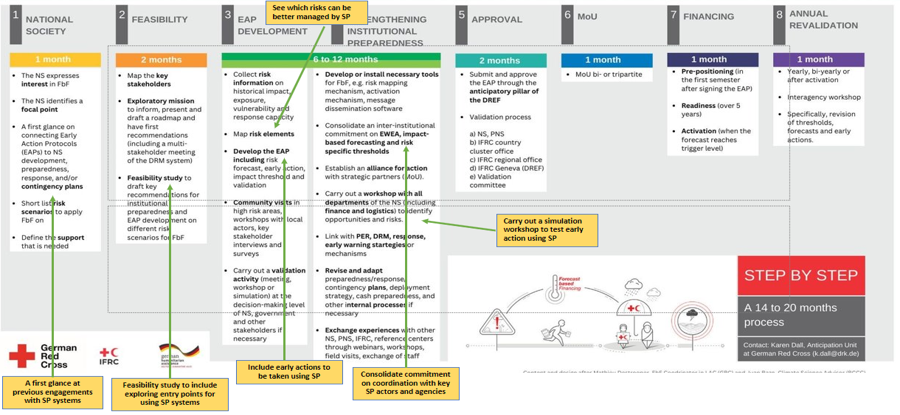
Concretely, to take this agenda forward, National Societies will need to work together with relevant sectors, such as social protection practitioners, disaster risk managers, climate and social science scientists and align with ongoing priorities and initiatives. In the infographic below, the key points where National Societies could seek to engage and integrate with social protection system within the Early Action Protocol development process has been identified.

Step 1: Understand the context

First, it will be important to understand the existing national social protection policy and program context to identify entry points and feasibility of leveraging existing systems. Apart from leveraging existing programs, a scoping can be done to determine if any new social protection policies are being drafted or an old one is being updated/reformed, and to explore opportunities to ensure that a future social protection program is anticipatory by design.

Step 2: In-depth technical analysis

As part of the design of an anticipatory action programme, it is important to understand how hazards impact people’s lives and livelihoods. When linking with social protection mechanisms, it will be key to conduct robust technical analysis that show where and how climate vulnerabilities and exposure overlap with existing social protection programme beneficaries and delivery channels (e.g. bank account coverage), so that anticipatory action using such systems can reach those affected wherever, whenever. In this regard, it will be important to understand what data is available with whom, how it relates to climate-related vulnerabilities, how frequently it is updated, etc.

Step 3: Advocate linkages between anticipatory action and social protection programs and systems

When social protection programs already exist and there is a common interest in making them scalable by integrating anticipatory action, it will be important to jointly advocate and collaborate to agree on the specific actions that can be taken through such programmes; and for this, capacity and resources are key. As part of the anticipatory action scoping study and advocacy strategy, it is essential to identify and agree on who is doing what and where in terms of social protection (past, present and planned interventions). If studies show that social protection programs might not be ready to take anticipatory action, there might still be opportunities to use components of systems, like beneficiary registries and payments/communications channels.

Step 4: Prioritize dialogue and understanding

It is key to promote dialogue and understanding across sectors and establish a process that aims to align and converge objectives of social protection and anticipatory action interventions at policy and program level. This needs to be anchored by coordination platforms/working groups that allow for continued dialogue and exchange.

Step 5: Start simple, build commitment

Depending on the local situation, anticipatory action could be introduced in phases, first targeting the most predictable hazards with relatively simple and affordable anticipatory actions using common social protection instruments (e.g. cash transfers), and then expanding to more complex actions or less predictable events. It will be important that donors and governments commit to fund this and assess the outcomes of their social protection investments to look at whether anticipatory actions have been taken and what difference they have made.
What should be kept in mind when integrating anticipatory action and social protection?

There are several opportunities when linking the two approaches, but also a few challenges and considerations to be aware of. Some of these include:

The success of anticipatory action relies heavily on accurate and timely weather or disaster predictions. Uncertainties in forecasting can lead to false alarms that trigger unnecessary interventions or missed events that prevent timely action. Since social protection systems are often nationally owned and implemented by government actors, it is important to design and incorporate anticipatory action in a way that carefully considers the credibility and reputation concerns.

Reliable data is crucial for effective integration, but many vulnerable regions lack adequate/updated data on climate risks, social vulnerabilities, institutional capacities, and the specific needs of communities. Insufficient data can hinder the provision of accurate forecasts and effective social protection measures. To address this, National Societies may need to map and coordinate with multiple stakeholders and identify who holds what data that could support an integrated intervention. Social protection ministries are a particularly important data source, as they typically maintain beneficiary registries containing household-level information that can directly support geographic and demographic targeting of anticipatory transfers. Once relevant datasets and the responsible institutions have been identified, a Memorandum of Understanding (MoU) should be established with the data-holding ministry, setting out the terms for data collection, storage, use, and disposal in the context of the anticipatory action intervention. An example template has been developed to support National Societies in this process and can be used as guidance (see toolbox).

While social protection programs often target the most vulnerable, in some cases, those most affected by a particular climate hazard might not be those that are traditionally considered vulnerable under a social protection approach and are enrolled in existing programs’ registries. Understanding climate-related vulnerability to individual or multiple hazards is key to aligning targeted populations for a joint anticipatory action-social protection approach. To support this, National Societies could play a crucial role in expanding social registries or developing beneficiary lists to complement existing social protection databases and include indicators on climate vulnerability. For guidance on targeting strategies see (see toolbox).

Understanding specific climate-related vulnerabilities and the historical impacts of disasters is essential for prioritising actions within a joint anticipatory action-social protection system. For instance, the type of support originally provided through a social protection mechanism (public works, cash or in-kind) might not help households to address, cope with or prepare for the impacts from a specific shock that the anticipatory action program is intended for. An understanding of potential shock impacts on targeted populations and the type of support needed is key. Also, anticipatory action is not likely to eliminate completely the need for ex-post response – though it could significantly reduce it – and appropriate response actions will still be needed.

Integrating anticipatory action with social protection requires collaboration between various stakeholders, including meteorological agencies, government bodies, humanitarian organizations, and local communities. Achieving effective coordination among these diverse entities can be challenging due to differing priorities, mandates, and operational structures. A practical starting point in this regard has been the establishment of cash working groups (e.g. the KRCS is part of the Kenya Cash Working Group) and anticipatory action technical working groups and the inviting of social protection actors to engage in such platforms.

Differences in policies, regulations, and institutional frameworks across the social protection and disaster management sectors (primary sector leading national anticipatory action efforts) and levels of government can impede integration efforts. Establishing a coherent legal and regulatory environment that supports the integration of anticipatory action and social protection is essential. Sometimes, this could be addressed if National Societies engage with contingency plans or disaster management plans of the government, promote anticipatory action and social protection approaches and help establish this as a priority for relevant sectors and officials in national governments.

Many regions, particularly in low-income countries, may lack the capacity to implement and sustain integrated systems. This includes technical capacity for forecasting, institutional capacity for social protection, and community capacity for preparedness and response. National Societies could start by improving their own capacity in terms of understanding social protection and implementing anticipatory action and identifying opportunities in linking the two and then engage in activities with relevant actors as well as communities to share lessons learned and find ways to build on this vision.

Financing of an anticipatory action system requires overcoming significant challenges in the way funding is structured. Integrating the two may pose challenges in terms of securing adequate funding, aligning budgetary cycles, and ensuring sustained support for both proactive and reactive measures. However, channelling financing through an existing social protection system might be cost-efficient, and contingency funds or budget reserves from programme funds could be used. Additionally, sustainable sources of financing would be required for longer term, sustained action at scale, and National Societies could potentially seek to engage with climate financing and global climate funds that can provide funding to social protection programs for taking anticipatory action.

Toolbox

Virtual Trainings

Publications

Case Studies

Platforms and Support