Considerations for non-weather hazards

Summary

This chapter reflects some of the particular considerations to take into account when applying anticipatory action to hazards and humanitarian impacts that extend beyond weather-related events. It introduces approaches and operational considerations for anticipatory action related to health and displacement impacts, and provides a brief outlook on emerging approaches for other hazards, such as wildfires or locust plagues. While the general steps to develop an s/EAP or pursue any other approach to anticipatory action are similar for weather-related hazards and non-weather-related hazards, this chapter carves out the particular challenges, rationale, and operational entry points to apply the concepts and mechanisms of anticipatory action to non-weather-related hazards. The chapter draws on operational experience, technical guidance and approved s/EAPs from across the Red Cross Red Crescent Movement and provides links to relevant templates, working groups, guidance documents, and examples for further exploration.

Anticipatory action and health

Why anticipatory action and health?

Disease outbreaks and epidemics cause widespread human suffering and loss while also generating significant social and economic consequences. Not everyone is affected equally: some people may have better access to healthcare, clean water, functioning sanitation systems, or be less susceptible to infection. The COVID-19 pandemic further underscored the importance of understanding different vulnerabilities, and how these can be unequally intensified when multiple hazards, such as epidemics and climate change, coincide.

Our ability to predict outbreaks of some high-burden, endemic diseases is improving, as we improve our understanding of the underlying drivers of transmission and have more high quality historic data over many years from which to identify associations. For certain, ‘climate-sensitive’ infectious diseases (i.e. diseases which respond to small changes in the climate), it may even be possible to harness the use of climate and weather forecasts to better anticipate the risk of future outbreaks. These developments are creating new possibilities to design, implement, and scale anticipatory action in health, including efforts to prepare for infectious disease outbreaks.

A working group on anticipatory action and health

The Red Cross Red Crescent Working Group on Anticipatory Action and Health brings together colleagues from across the RCRC Movement to advance efforts to anticipate and prevent negative health and nutrition outcomes before they escalate. Open to staff working in disaster risk reduction, health, WASH, anticipatory action and related fields, the group serves as a platform for stronger collaboration, knowledge exchange and the development of practical tools and approaches. Building on the extensive experience of National Societies, particularly in outbreak preparedness and response, the working group seeks to strengthen the evidence base for anticipatory action in health and nutrition and support the development of early action protocols for specific health risks. A key milestone in this work was the publication, in October 2024, of the working paper Applying Anticipatory Action Ahead of Disease Outbreaks and Epidemics: A Conceptual Framework for the International Red Cross and Red Crescent Movement and a scientific publication Integrating anticipatory action in disease outbreak preparedness and response in the humanitarian sector (see toolbox below) on which the following guidance is based. Hence, if you want to know more please refer to those two resources.

Approaches to anticipatory action for disease outbreaks and epidemics

Four main approaches are emerging for the development of anticipatory action triggers for disease outbreaks, reflecting the different types of data, forecasts and risk information available in your contexts. These approaches range from the use of real-time surveillance data and climate or weather forecasts to combinations of observed risk factors and more advanced modelling to predict disease outbreak risk. The variety of possible trigger approaches offers a practical framework for selecting trigger systems suited to specific diseases, settings and operational capacities. Click on the approaches to learn more!

Real-time surveillance data can be used to trigger rapid outbreak responses when predefined thresholds are met, whether in affected communities, nearby cross-border regions, or during the emergence of new pathogens. Linking these triggers to automatic early funding could speed up action, improve detection, and help contain transmission before outbreaks escalate.

Weather forecasts can be used as early warning triggers for certain disease outbreaks because there is evidence that floods, cyclones, drought, or heat  can create conditions that are conducive to increased disease transmission. The core idea is to use a forecast of an extreme weather event (as is used for hydro-meteorological hazards) to implement  low- to no-regrets health related actions that are aimed at preventing disease transmission , especially in places where past evidence shows a strong link between specific climatic events and diseases such as cholera or diarrheal illness. This approach can help reduce outbreak risk in advance and can later be paired with real-time surveillance to guide more targeted response if cases appear. This approach is already implemented in many EAPs.

Observed environmental and socioeconomic risk factors can be combined with real-time disease surveillance data to trigger phased early action before outbreaks escalate. The main idea is that factors such as flooding, displacement, overcrowding, or conflict can increase disease transmission risk, and potentially give a few days to weeks (depending on the disease) lead time in which to act. Disease surveillance data can then be used confirm whether cases are emerging or increasing and where should be targeted for more intensive action to interrupt transmission. Using these signals together allows your National Society to ideally receive funding earlier, start broad low-regret preventive measures when risk is increasing, and then shift to more targeted outbreak control once suspected or confirmed cases appear.

Depending on the availability of historic disease data, in some cases it is possible to invest in the development of mathematical models for disease outbreak prediction on when and where outbreaks are likely to occur. The development of such models requires substantial historical disease, climate, environmental, and ideally demographic data (>10 years of weekly or monthly disease cases or incidence in addition to the same amount of climate, environmental and demographic data) as well as modelling, epidemiological, statistical, and disease specific expertise. Models can be developed that identify associations between the disease data and available climate and environmental data. For example, an outbreak of a disease may be associated with increased rainfall that happened 2 months prior to the outbreak. The model can therefore use observed rainfall to predict the likely occurrence of an outbreak 2 months later. If a forecast of rainfall is used in the model instead of the observed rainfall, this can potentially extend the lead time for early actions by more than 2 months. The model forecasts can then be turned into trigger thresholds for anticipatory action, helping to release funding and start preventive measures potentially weeks to months in advance. These trigger thresholds can be combined with real-time surveillance data to increase the release of emergency funding and target breaking the transmission chain if cases do emerge as predicted as a means to bridge to full-scale response.

The Mozambican Red Cross as an example of using weather forecasts to trigger early action for waterborne diseases (Approach B)

The Mozambican Red Cross Cyclone EAP shows how weather forecasts can be used to trigger early actions to reduce the risk of diarrheal disease following tropical cyclones. In line with the national level Standard Operating Procedures for cyclones issued by the government agency for disaster risk management (INGD), the protocol uses a windspeed forecast with an activation threshold of expected landfall winds of at least 119 km/h, issued 72 hours in advance by Mozambique’s national meteorological service, as the trigger for action. Because events of this magnitude are expected to cause substantial damage to water and sanitation infrastructure, the lead time is used to implement early actions such as refresher training for community volunteers on water treatment and hygiene materials, alongside the distribution of WASH supplies including buckets, mugs, jerrycans, soap, and water purification tablets. These actions are intended to reduce the risk of waterborne disease transmission before the cyclone makes landfall.

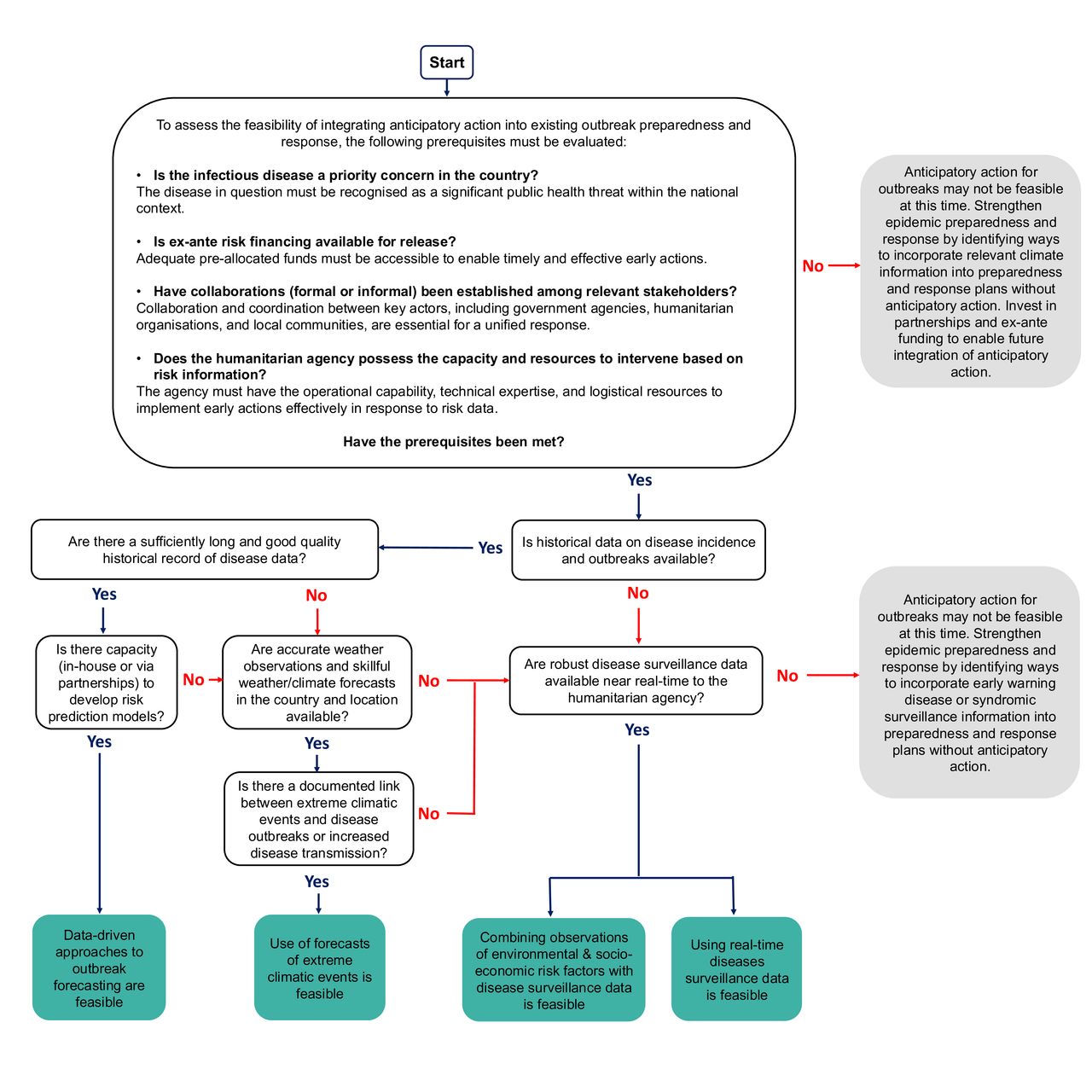
A decision tree to support discussions on anticipatory action for disease outbreaks and epidemics

In the publication Integrating anticipatory action in disease outbreak preparedness and response in the humanitarian sector by Alcayna et al. you find a decision tree intended to help National Societies and other organizations to assess whether anticipatory action for epidemics is appropriate in a specific context. It can help you identify which approach is likely to work best based on the disease of interest, the availability of relevant data, and the presence of partners, such as ministries of health or academic institutions, that may already be involved in early warning for disease outbreaks.

Funding for AA and epidemics under the IFRC-DREF

Anticipatory action for epidemics is not currently eligible under the Imminent DREF. However, funding for epidemic preparedness may be available through the response pillar. In such cases, the IFRC health team reviews the request and determines whether it should be approved as preparedness support or as a response intervention. Depending on the context and available evidence, requests may draw on forecast information, government surveillance data, and other relevant sources.


Anticipatory action and displacement

Why anticipatory action for displacement impacts?

Population movement, whether driven by conflict, economic hardship, food insecurity, climate stress, or a combination of these, can generate interconnected humanitarian pressure that extend well beyond the initial movement. People on the move might face disruptions to health, psychosocial wellbeing, family unity, and access to basic services and protection. Meanwhile, host and transit communities can experience strain on essential services, market fluctuations, and potential social tension. Surrounding environments come under pressure through unplanned demands on water sources, waste systems, and national resources. These (secondary) humanitarian impacts are often foreseeable, even when the precise scale and timing of the movement itself are not.

In this context, anticipatory action focuses on anticipating the humanitarian needs that arise as conditions shift from manageable to acute and acting early enough to reduce their severity, rather than aiming to predict displacement itself. Drawing on a combination of external data sources, government statistics, and community-level observations, National Societies can identify emerging signals and inflection points that indicate when coping capacities of migrants en route or host communities as well as the capacities of (humanitarian) support systems are beginning to deteriorate. This approach, grounded in the IFRC’s technical guidance on anticipatory action for population movement (see toolbox), emphasizes low-regret actions based on credible information rather than certainty, shifting the focus from predicting events to positioning humanitarian actors to act earlier before humanitarian impacts peak and thus to act more effectively within the fluid realities of human mobility.

Coordination and working groups on anticipatory action and displacement

Within the Red Cross Red Crescent Movement, the IFRC-DREF’s Anticipatory Pillar convened a technical Working Group on Anticipatory Action for Population Movement from January 2024 to December 2025. Bringing together several National Societies (including the American, Australian, British, Danish, German and Netherlands Red Cross), IFRC departments, and the Red Cross Red Crescent Climate Centre, this timebound initiative was tasked with clarifying when and how anticipatory action driven by Red Cross Red Crescent Movement actors could meaningfully apply to migration and displacement contexts, particularly where population movement is driven by multiple, overlapping pressures rather than a single hazard. Its work produced three main outputs: a technical guidance note, an sEAP proforma template tailored to population movement and considerations for s/EAP validation criteria, all of which inform the guidance in this chapter (see resources below). At the global level, the Working Group on Anticipatory Action for Displacement, co-chaired by the International Organization for Migration (IOM) and the Danish Refugee Council (DRC) and hosted by the Anticipation Hub, promotes broader technical collaboration, evidence-building, and joint advocacy to strengthen anticipatory approaches in displacement settings across the humanitarian systems. Both initiatives reflect the potential of anticipatory action to expand beyond climate and weather hazards to address the complex, multi-driver realities of human mobility.

Guiding principles for anticipatory action and population movement

Before identifying where anticipatory action can make a difference and how it can be operationalized along the displacement timeline, it is important to establish the principles that should guide the design, review, and implementation of anticipatory action in displacement contexts. The IFRC technical guidance sets out five central principles:

The objective is not to forecast displacement precisely, but to strengthen readiness for when early signals of rising humanitarian need emerge. Anticipatory action focuses on positioning actors to act earlier rather than waiting for complete information or impact peaks to materialize.

Assessments should centre on humanitarian impacts, particularly when conditions indicate rising vulnerability or pressure on essential services, rather than on the scale or probability of movement alone.

Expectations for data quality must be realistic and aligned with what is feasible and accessible in a given context. Where quantitative data are partial or incomplete, credible expert judgement and qualitative information remain essential for informing decisions.

Anticipatory action must neither encourage nor deter movement. This extends to how triggers are designed and communicated, avoiding framing or data use that could influence migration choices or compromise the principled nature of humanitarian assistance.

Consistent with the Movement’s principles of universality and impartiality, the guidance intentionally avoids diving population movement into fixed types such as internal, cross-border, or mixed. Each context should be assessed on a case-by-case basis to ensure that all at-risk people are considered based on their needs, not their legal status.

These principles underpin both the analytical framework for understanding anticipated impacts and the operational approaches for acting on them, which the following sections outline.

Dimensions of anticipated displacement impacts

Having established why anticipatory action is relevant and what principles should guide it, the next question is what types of displacement impacts can be addressed through anticipatory action. Migration and displacement create interconnected humanitarian pressures that extend beyond the initial act of movement. The IFRC technical guidance identifies three dimensions through which these evolving impacts can be anticipated and acted upon.

  • People on the move face disruptions to health, psychosocial wellbeing, family unity, and access to basic services and protection, including reliable information and safe referrals. In Djubouti, for instance, the sEAP documents how migrants transiting toward the Arabian Peninsula walk for weeks through arid terrain with virtually no access to water, food, or medical care, while remaining largely unaware of their rights or available services. In Colombia, people forcibly displaced by armed conflict in the Pacific region face prolonged periods in inadequate shelters, loss of livelihoods, and severe psychosocial strain.
  • Host and transit communities experience pressure on essential services, market fluctuations, and potential social tension. In Djibouti, host communities along transit routes already provide the majority of informal support to people on the move, such as water, food, and economic exchange, but report that this assistance is insufficient to meet the scale of need when impacts peak. In Honduras, municipalities along common migration corridors see their local capacities regularly overwhelmed during peaks in transit flows.
  • Environment and infrastructure come under stress through unplanned demands on water sources, waste systems, and natural resources, particularly in contexts of prolonged or large-scale displacement, where settlements are not always planned or designed for services to absorb sudden population increases.

By examining these three dimensions, National Societies can identify which risks are most relevant in their context. The following section outlines how anticipatory action for the identified risks and impacts can be operationalized along the displacement timeline.

Approaches for operationalizing anticipatory action along the displacement timeline

The previous section identified what anticipatory action for displacement impacts should address, while this section turns to how it can be put into practice. The IFRC technical guidance and the accompanying sEAP proforma template structure operational design around three stages of the displacement timeline: at the place of origin, in transit, and at longer-term displacement or settlement sites. Which early actions might be feasible or impactful might shift at each stage, and each intervention might be classified differently depending on where in this timeline it falls.

At the place of origin, anticipatory action may focus on early outreach, coordination with authorities, and measures that support safe decisions before movement begins or escalates. Lead times at this stage can be longer, but signals may also be less precise. The IFRC sEAP proforma template outlines a range of illustrative activities for origin contexts, including community information on rights and available services, health checks, distribution of dignity kits and other essential items, coordination with authorities, and the dissemination of messages to prevent family separation. As operational experience grows, this stage may become a more prominent feature of future protocols particularly in contexts where seasonal or cyclical movement patterns provide sufficient lead times.

In transit, lead times are typically shorter and actions need to be implementable rapidly along known routes. The Djibouti sEAP, for example, is designed specifically around this stage: migrants crossing from the Horn of Africa toward the Arabian Peninsula walk for approximately two to three weeks across the country, providing a window to deploy services at entry points, along transit routes, and at regrouping and existing points. The protocol uses IOM Displacement Tracking Matrix weekly flow monitoring data as its trigger, with a fixed threshold that has been identified through return-period analysis of six years of historical data. When the threshold is met, the Djibouti Red Crescent activates early actions including safe water provision, hygiene kit distribution, first aid, and psychosocial support along the transit corridor. Similarly, the Honduran Red Cross EAP, that, two years after its initial approval, needed a revision to reflect shifting dynamics in Central America movement flows following changes in US migration policy, uses a two-indicator trigger combining upstream movement data from Panama with an assessment of national response capacity. When both indicate rising volumes of movement and diminishing capacities, early actions are implemented at humanitarian service points along the migration corridor, focusing on WASH, health, psychosocial support, restoring family links, and protection referrals.

At longer-term displacement or settlement sites, early action shifts towards preventing the secondary deterioration of conditions for both displaced populations and host communities. In Colombia, for example, the sEAP for complex crisis in the Pacific region addresses this stage: it is activated when specific institutions issue alerts indicating that a mass displacement event linked to armed conflict has occurred or is imminent in one of the four target departments. Displaced communities typically arrive in larger towns or municipal capitals where they settle in temporary shelters that lack adequate infrastructure. The sEAP particularly targets the gap between the onset of displacement and the point at which local authorities can deliver the full response as mandated by national law, a period during which displaced people often have no access to clean water, health services, or psychosocial support. Early actions include deploying water treatment capacity and storage, distributing hygiene kits, providing physical and psychological first aid, broadcasting radio messages on safe behavior in the presence of anti-personnel mines and unexploded ordnance, establishing child-friendly spaces, and conducting community workshops on gender-based violence prevention. Critically, the protocol also targets host communities in receiving municipalities to mitigate tensions that might arise when capacities and local services are strained by a (sudden) increase of the local population.

Across all three stages, a degree of predictability is essential for anticipatory action to function. Anticipatory action for population movement does not aim to forecast movement itself with the same precision that is possible in case of weather-related extreme events. Yet, it does require sufficient evidence, that can, for example, be drawn from historical patterns, trend data or scenario analysis, to identify when peaks in movement or arrivals are likely to exceed existing capacities. The underlying logic is that displacement-related needs often follow recognizable patterns: movement along established corridors tends to fluctuate, and past events provide a basis for identifying thresholds beyond which available services and response capacity are overwhelmed and conditions begin to deteriorate. It is this predictive element that distinguishes anticipatory action from response. In contexts where no such patterns can be identified and displacement-related impacts cannot be modelled or anticipated with any reasonable confidence, an EAP may not be the appropriate instrument; other mechanisms such as the imminent DREF or response DREF may be better suited to address the crisis.

Where sufficient data and / or patterns do exist, the design of triggers and thresholds is a central operational challenge. The s/EAPs that have been approved illustrate different approaches to trigger design: The Djibouti sEAP, for instance, relies on quantitative flow monitoring data with a statistically derived threshold; Honduras combines upstream movement data with a structured capacity assessment and consensus-based expert judgement; and Colombia draws on official institutional alerts linked to department-level displacement thresholds. The IFRC guidance further distinguishes between single-phase triggers, which initiate action once a predefined threshold is reached, and multi-phase triggers, which enable an initial low-regret activation followed by more targeted actions once field confirmation is available. In all cases, triggers should be linked not only to movement volumes but also to indicators of humanitarian severity, such as rising unmet health or protection needs, reduced access to essential services, or strain on host community resources to ensure that activation reflects deteriorating conditions rather than movement alone.

Other hazards

While the preceding sections address health and displacement, two areas where dedicated technical guidance and multiple s/EAPs now exist, the Red Cross Red Crescent Movement is also beginning to extend anticipatory action to other hazards that do not fit neatly into established climate or weather forecasting systems. This section briefly outlines emerging considerations for such hazards. In these cases, operational experience remains limited; the guidance offered here is therefore deliberately concise and should be understood as reflecting early-stage practice.

Wildfires

Wildfires present a growing humanitarian challenge, particularly in regions where climate change, expanding agro-forestry land use, and the growth of settlements in fire-prone rural areas are increasing both the frequency and severity of fire events. The speed at which wildfires spread, combined with the scale of potential impact on homes, livelihoods, and human safety, makes them a hazard where acting ahead of impact peaks can significantly reduce harm, yet their inclusion in anticipatory action frameworks is still very recent.

The Chilean Red Cross sEAP for wildfires, developed with technical support from the German Red Cross, the Red Cross Red Crescent Climate Centre, and the IFRC, is the first and currently only approved wildfire sEAP within the Movement. It was activated for the first time in January 2026 in the Araucanía region, marking a global milestone for anticipatory action on this hazard. The protocol targets communities in central-southern Chile exposed to wildfire risk and focuses on three priority impacts: damage and loss to homes, overexposure of people attempting to combat fires without adequate protection, and loss of livelihoods.

A distinctive feature of the sEAP is its trigger mechanism, which draws on fire-behavior forecasting rather than weather forecasts alone. The protocol is activated when conditions known as the “Red Button” are met: An ignition probability equal to or greater than 70%, wind speeds of at least 20 km/h, and relative humidity below 30% in the targeted territory, with forecasts maintaining these conditions eight days in advance. These conditions are monitored by Chile’s National Forestry Corporation (CONAF), which produces fire-spread forecasts, while the National Disaster Prevention and Response Service (SENAPRED) issues the formal alerts. The protocol also includes a stop mechanism: an updated forecast three days after activation confirms whether conditions still exceed the thresholds or whether the probability has decreased. Upon activation, the Chilean Red Cross implements early actions including multipurpose cash transfers, for example to cover costs for transportation, evacuation or storage of assets, as well as evacuation kits and protective tools for vulnerable households, and coordination with local authorities and community leaders. During the January 2026 activation, the protocol reached approximately 400 families within the eight-day implementation window, in an area that had not yet been directly affected by the fires spreading elsewhere across the country.

The Chile experience illustrates several broader considerations for wildfire-related anticipatory action:

  • Consider a combination of environmental variables, such as ignition probability, wind, and humidity, rather than a single forecast product as a basis for your trigger model. This requires close collaboration with national fire and meteorological agencies.
  • Take into account that lead times tend to be short (days rather than weeks), which demands a high emphasis on readiness activities, pre-positioned supplies, and volunteer training. As with all sudden-onset hazards, these activities should already be in place before the fire season begins.
  • Establish a robust stop mechanism. While this is good practice for many different hazards and a specific requirement in s/EAPs, the inherent uncertainty might be even bigger for fire-behaviour forecasting. Against this background, it is essential to have a solid mechanism in place that allows resources to be scaled down or relocated if conditions change.
  • Capture and share learnings from wildfire-related anticipatory action initiatives even if they do not result in an s/EAP. As operational experience accumulates not only from this or future activations, but also from any other related initiatives, learnings should be captured systematically to inform the application of the concepts and mechanisms of anticipatory action in other fire-prone contexts.

Desert locusts

Desert locusts are among the most dangerous migratory pests in the world because they can rapidly multiply, form massive swarms, and move across countries in a short time. A single swarm can contain millions to billions of locusts, devouring crops, pasture, and natural vegetation wherever it lands. This makes them a major humanitarian threat, especially in vulnerable regions where people depend heavily on farming and livestock for food and income. When locust swarms destroy harvests and grazing land, they can trigger food shortages, loss of livelihoods, rising prices, and greater poverty.

The Somali Red Crescent Society has developed the first sEAP for desert locusts. It is designed to protect food security and livelihoods by acting before outbreaks reach crisis level. It focuses on high-risk pastoral and agropastoral areas and combines surveillance, early warning, advisory support, and multi-purpose cash assistance to help vulnerable households reduce losses.

The protocol follows a two-stage trigger system. First, a readiness trigger is activated when FAO bulletins and national monitoring show likely breeding or possible migration of locusts into Somalia within the coming six weeks. This leads to increased surveillance and preparedness. Second, an activation trigger is reached when the National Desert Locust Centre (DLC), using field survey results and satellite data, confirms that locusts pose an imminent threat to crops and food security. This then triggers wider early warning dissemination and targeted cash assistance.

The main actions include strengthening locust surveillance, sharing early warning and advisory messages through volunteers and media, and providing cash transfers to vulnerable households so they can take protective measures such as buying food, fodder, tools, or other essentials.

Implementation depends on close cooperation between the Somali Red Crescent Society (SRCS), which leads delivery on the ground, and the National Desert Locust Centre, which provides technical surveillance and trigger analysis.

Toolbox